The food import bill hit $7.3 billion last year. That number gets repeated a lot. In the news, in budget speeches, in the kind of panels where people use phrases like "value chain optimization." The number is so large it stops meaning anything. Seven billion dollars. More than the government spends on its Public Sector Investment Programme. Almost double what the country spent on imported food in the early 2000s13
But here is what that number actually means for a household. Every time you buy a sweet pepper grown in a hydroponic greenhouse in Holland or a pumpkin that traveled on a container ship from somewhere you cannot pronounce, you are paying for diesel, foreign exchange, shipping logistics, import duties, and a middleman who took his cut. You are also paying for the structural failure of the local agricultural system. Agriculture now contributes less than one percent to GDP, down from $1.4 billion to roughly $650 million over the last decade5.
The food on your plate crossed an ocean. That is not abundance. That is a vulnerability.
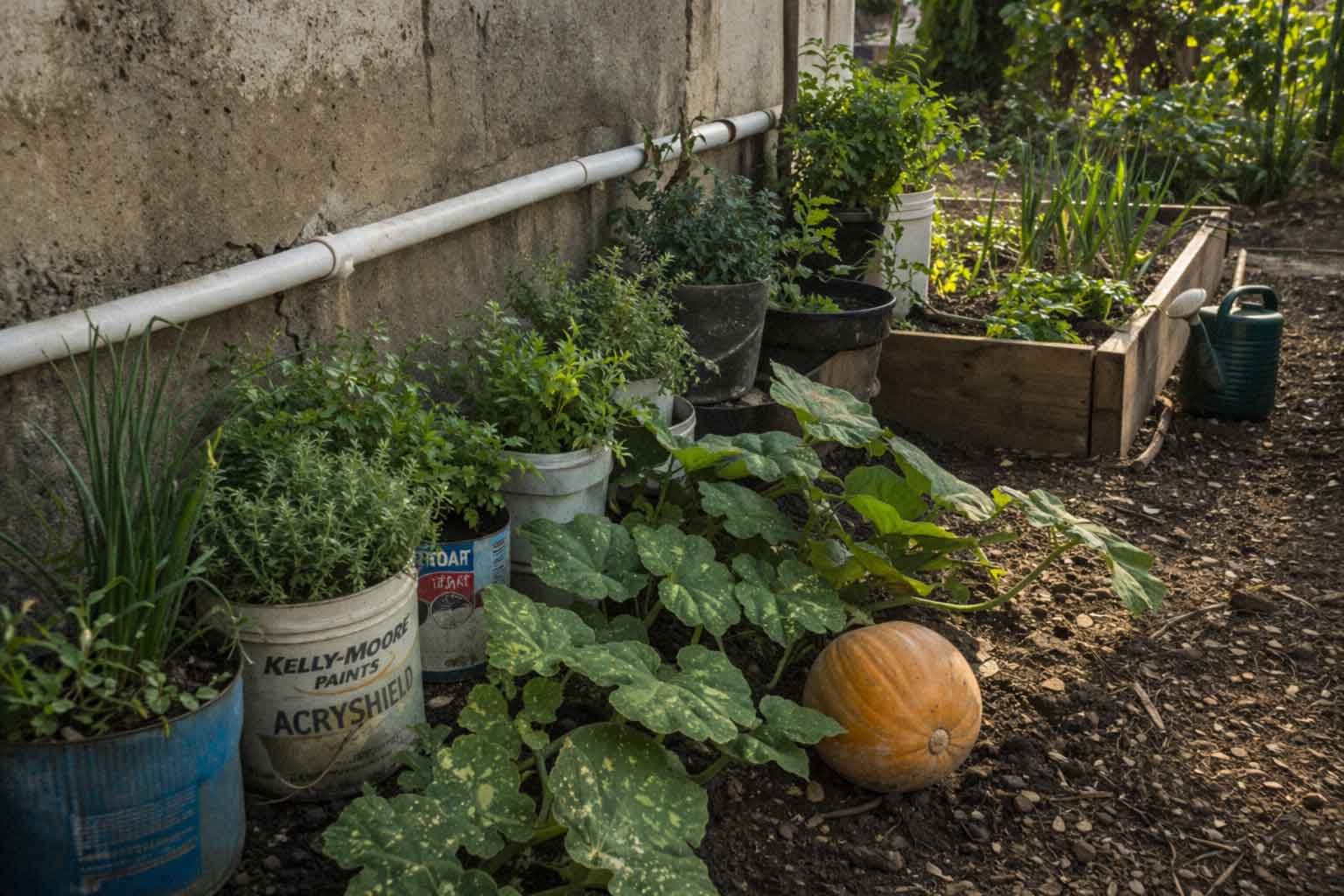
Here is something I believe plainly. The kitchen garden is not a sentimental throwback. It is the only honest response to a system that spends $7.3 billion on things that could grow in a paint tin by the back step.
The $7.3 billion hedge
Think about that import bill as a household problem. Because that is where it ends up. The government can talk about the "25 by 2025" CARICOM target to reduce regional food imports, but the deadline has already slipped and the goal looks increasingly unrealistic1 2. The Ministry can allocate $1.13 billion to agriculture, with nearly $800 million going toward agri tech projects, artificial intelligence farming, and smart agriculture2.
That is fine. But none of that money is going to save you when the price of potatoes doubles because a shipping container got stuck in a port strike somewhere else.
The backyard garden works on a different logic. It does not depend on foreign exchange. It does not care about the Russia Ukraine conflict or the latest shipping logistics crisis1. It requires no ministry approval, no grant writing, no subsidy application. Just soil, seed, water, and someone willing to get their hands dirty.
The financial yield is not theoretical. Take the chives you buy in the supermarket. A small plastic wrapped package costs three to five dollars. A single chive plant in an old paint tin costs maybe fifty cents for the seed and nothing for the container. That plant will produce the equivalent of that supermarket package every week for months. The same applies to thyme, shado beni, and every other herb that makes Trinidadian food taste like Trinidadian food.
Or consider pumpkin. Commercial yields can reach 8,000 to 10,000 pounds per acre in about three months5. Scale that down to one vine in the corner of a yard. That single vine, properly tended, can produce several pumpkins over a season. Each pumpkin you do not buy at the supermarket is money that stays in your pocket. More importantly, it is money that does not get converted into United States dollars to pay a foreign farmer. Every homegrown pumpkin is a tiny currency intervention.
The minister in the Ministry of Finance recently pointed out that luxury food items deplete foreign exchange even while the country needs that same foreign exchange for essentials4. But here is the uncomfortable truth. What counts as a luxury depends on where you are standing. To the person with a steady income, a imported red pepper is a convenience. To the household feeling the squeeze of food inflation which has averaged nearly eleven percent over the last decade and spiked as high as thirty nine percent, every item on the shelf is a calculation3.
The zero transportation advantage
This is where the kitchen garden beats commercial agriculture on a fundamental level that no amount of government subsidy can touch.
The commercial farmer has to get the food from the field to the market. That means trucks, fuel, drivers, maintenance, road quality, spoilage, and a distribution network that in Trinidad is famously inefficient. The farmer also has to deal with the aging rural population, neglected infrastructure, poor watercourse management, and flooding that has driven many farmers out of the sector entirely5.
Your backyard has none of these problems. The distance from soil to kitchen is measured in meters, not kilometers. The transportation cost is zero. The spoilage is whatever you leave on the vine too long. The labor is whatever you choose to put in.
This is not a small advantage. This is the entire advantage. The imported food system is expensive because it is complicated. The kitchen garden is cheap because it is simple. No shipping logistics. No foreign exchange. No middleman. Just a seed, some soil, and the willingness to wait.
The specific crops that matter
The government is currently running a pilot project focused on three specific commodities: soya bean, corn, and black eye peas5. The numbers tell you why. Trinidad imports over 300,000 kilograms of black eye peas annually. Soya bean oil imports alone exceeded $300 million in 20225. Corn imports for animal feed add another $250 million each year.
You cannot grow a corn field in a backyard. But you can grow a few rows of bodi. You can plant black eye peas along a fence line. You can harvest them dried and store them for months, replacing the bagged legumes you would otherwise buy at the wholesale. These are not romantic crops. They are not the kind of thing people photograph for Instagram. But they are the things that show up on the grocery receipt month after month.
The real financial yield of a kitchen garden is not the occasional novelty tomato. It is the steady replacement of every day items that you would otherwise buy. The pumpkin that becomes several meals of soup. The ochro that stretches a pot of fish broth. The herbs that make the difference between cooking and ordering out. These savings do not show up as a lump sum. They show up as a slower drain on the household budget. That is the payoff.
The limit of paperwork
The Ministry of Agriculture has announced a three year priority commodities program for fifteen high demand products, aligned with the revised CARICOM target to cut food imports by twenty five percent by 2030 2. The budget includes $793.7 million for agri tech projects, artificial intelligence farming, and smart agriculture 2.
None of that is bad. But none of it will matter if people do not also go outside and plant something. The kitchen garden is not a policy. It is a practice. It does not require a committee or a feasibility study or a foreign exchange allocation. It requires someone to take a seed, put it in the ground, and wait. That waiting is the part that cannot be optimized or accelerated or funded into efficiency. It is also the part that actually works.
The $7.3 billion food import bill is the highest it has ever been1. The population has stayed flat for more than a decade, meaning we are not feeding significantly more people, just spending significantly more money to feed the same number of people3. Something in the system is broken. The kitchen garden does not fix the system. It bypasses it.
That is not a solution. It is a strategy. And it is one that requires no permission, no funding, and no approval from anyone except the person who decides to put a seed in the ground.