The glovebox never opened cleanly.
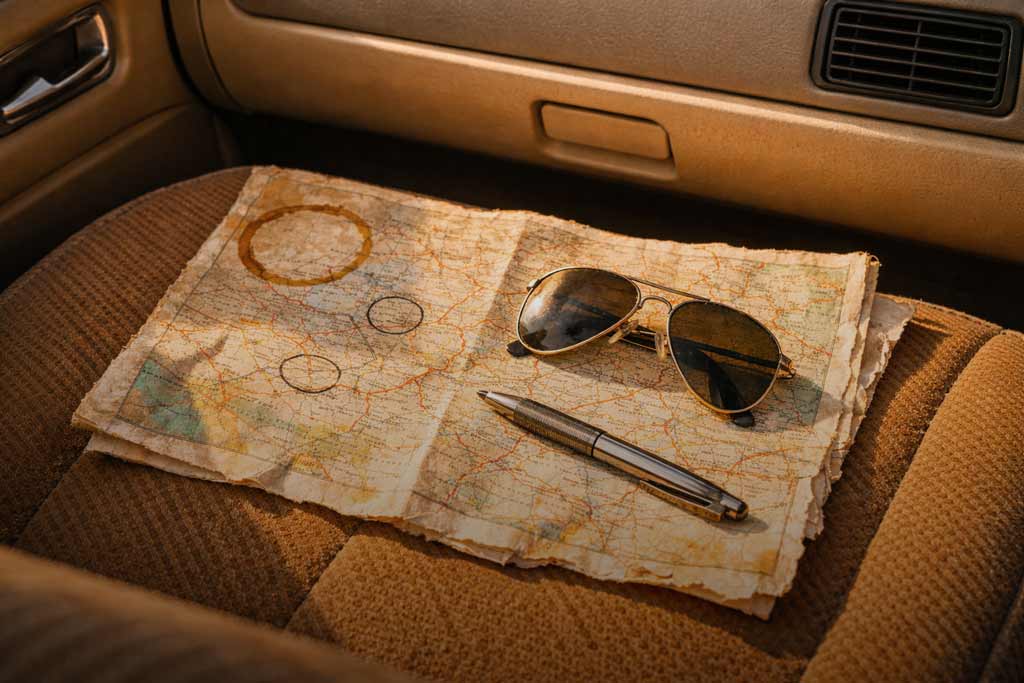
It stuck halfway, always, like it had something to hide. You had to pull it with a little more force than felt necessary, and when it finally gave way, everything inside shifted forward at once, receipts, a loose fuse, a pen that didn’t work, and the map.
The map was never folded properly.
You’d take it out carefully at first, trying to respect whatever system it once had, but the moment it opened past a certain point it lost all discipline. It spread wide, bigger than it had any right to be inside a car, edges brushing against the windshield, corners slipping over your lap.
“Hold this,” the driver would say, one hand still on the wheel, the other gesturing vaguely.
You’d grab a section, never the right one, and the whole thing would sag in the middle.
“Not there. There.”
And already, before the car even reached the turn, there was tension.
Being in the passenger seat meant you were responsible for something you couldn’t fully control.
You had to translate the map while the world moved past you in real time. Roads didn’t look like they did on paper. A clean line became a bend that felt too sharp, or too narrow, or not quite like what you expected.
“Is it this one?”
You’d look down. Look up. The road would split.
“Wait, no, keep going. Keep going.”
Too late. Indicator already on. The car easing into the turn.
A pause.
“…I think that was it.”
It never sounded convincing.
There was always a moment, maybe ten minutes later, when things started to feel off.
The houses didn’t match what you thought you’d see. The road stretched longer than it should have. Landmarks passed without meaning anything.
You’d go quiet first.
The map would come closer to your face. You’d trace the route again with your finger, slower this time, like the answer might appear if you gave it more attention.
“Are we on the right road?”
You wouldn’t answer immediately. Not because you didn’t hear, but because you were trying to decide how honest to be.
“…yeah. I think so.”
Another few minutes.
Then, softer:
“…maybe not.”
Getting lost didn’t arrive all at once. It settled in.
The car felt different. The air inside it changed. The driver leaned forward slightly, as if posture could correct direction. You kept looking between the map and the road, as though one of them might suddenly admit the mistake.
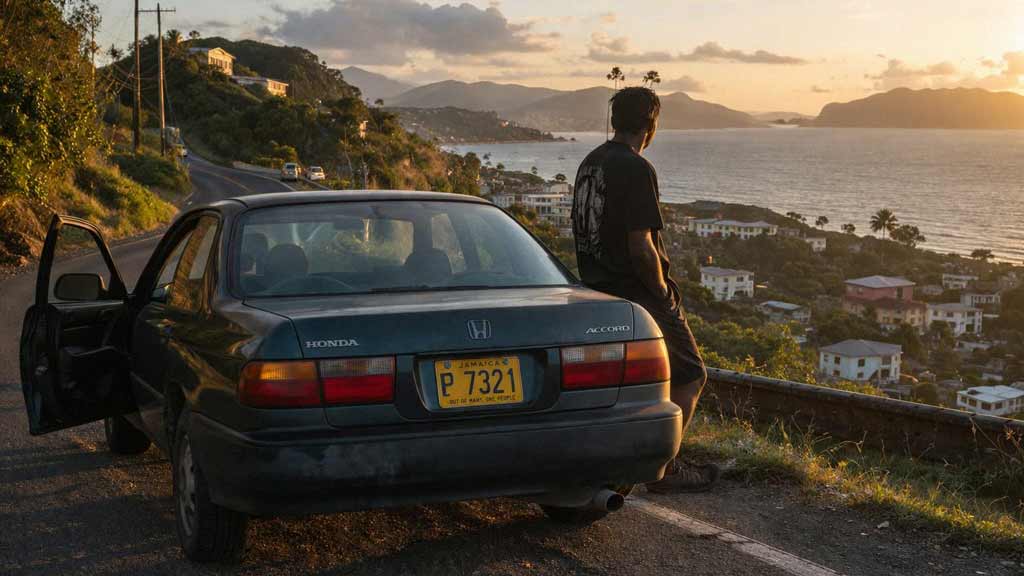
“Pull over by that gate.”
The engine idled. Heat rose slowly from the bonnet, visible in that faint wavering way.
The map came all the way open now, no more pretending to manage it neatly. It covered everything. The vents, the radio, part of the steering wheel.
You both leaned into it.
“This is us… right?”
A finger tapped the paper. Another followed, tracing a line that should have connected.
“No… wait. That’s the bridge we passed earlier.”
“Are you sure?”
A pause.
“…no.”
Sometimes someone would appear.
A man by a gate. A woman sweeping a yard. You’d call out, explain where you were trying to go, and they’d nod in a way that suggested the route was obvious.
“Go back down, take the second left by the big tree, the one after the shop that used to be blue, and follow that straight until you see the hill.”
You’d thank them like they’d just handed you something valuable.
Back in the car, there’d be a brief, quiet optimism.
“Alright. Second left.”
“After the shop.”
“That used to be blue.”
You’d repeat it once more, just to hold it in place.
The thing about those drives is that you started to understand the place, even when you got it wrong.
You noticed how the road curved with the land, not against it. How certain turns dipped where water must have run for years. How the air changed as you climbed, cooler, thinner, carrying something you couldn’t quite name.
You weren’t just following a route. You were trying to make sense of it.
And sometimes, when you finally found your way, when the road opened up into something familiar or the coast appeared where it was supposed to, you felt it. Not relief exactly. Something quieter.
Like you had earned your way there.
The map never folded back the same.
You’d try, at the end. You always tried. Matching crease to crease, flattening it against your thigh, working section by section.
It resisted.
Lines wouldn’t align. Edges bulged out where they shouldn’t. The whole thing thickened into something awkward and uneven.
“Just put it back,” the driver would say.
You’d push it into the glovebox anyway, forcing it past the hinge until it caught again.
Next time it opened, it would be worse.
Now there’s no map.
No hesitation, either.
A blue dot sits quietly on the screen, perfectly certain of where you are. It doesn’t argue. It doesn’t second-guess. It doesn’t care if the road feels wrong, or if the turn comes sooner than expected, or if the landmark you were looking for has been gone for years.
It just speaks.
“Turn left in 200 meters.”
And you do.
You don’t ask why. You don’t look at the land. You don’t need to.
There’s no one in the passenger seat holding anything open, trying to keep track of where you might be. No one tracing lines with their finger. No one quietly realizing, before saying it out loud, that something doesn’t add up.
You arrive exactly where you intended to go. And later, if someone asked you how you got there, you probably couldn’t tell them.